Uberall is a B2B platform that helps businesses manage online visibility, reputation, and social engagement at scale. It supports SMBs and global enterprises with 10,000+ locations across Google, Facebook, Apple Maps, and other major platforms.

As Product Design Director, I led UX across 11 product squads, establishing scalable systems that improved team efficiency by 35%.
In 2025, we introduced the UB-I Agent, an autonomous agent capable of executing location-based actions across listings, reputation, and social workflows. This improved core users workflow task completion from ~62% to ~74%, reduced cognitive load by ~22%, and increased first-response success by ~30%, accelerating user outcomes and product adoption.
The Problem
Users were open to trying AI, but ~30% abandoned sessions when effort, risk, or uncertainty outweighed perceived value—often before a second interaction.

Primary Users
Marketing Experts
• High marketing and technical proficiency
• Manage 10–10,000 locations
• Use Uberall as a business-health and optimization platform
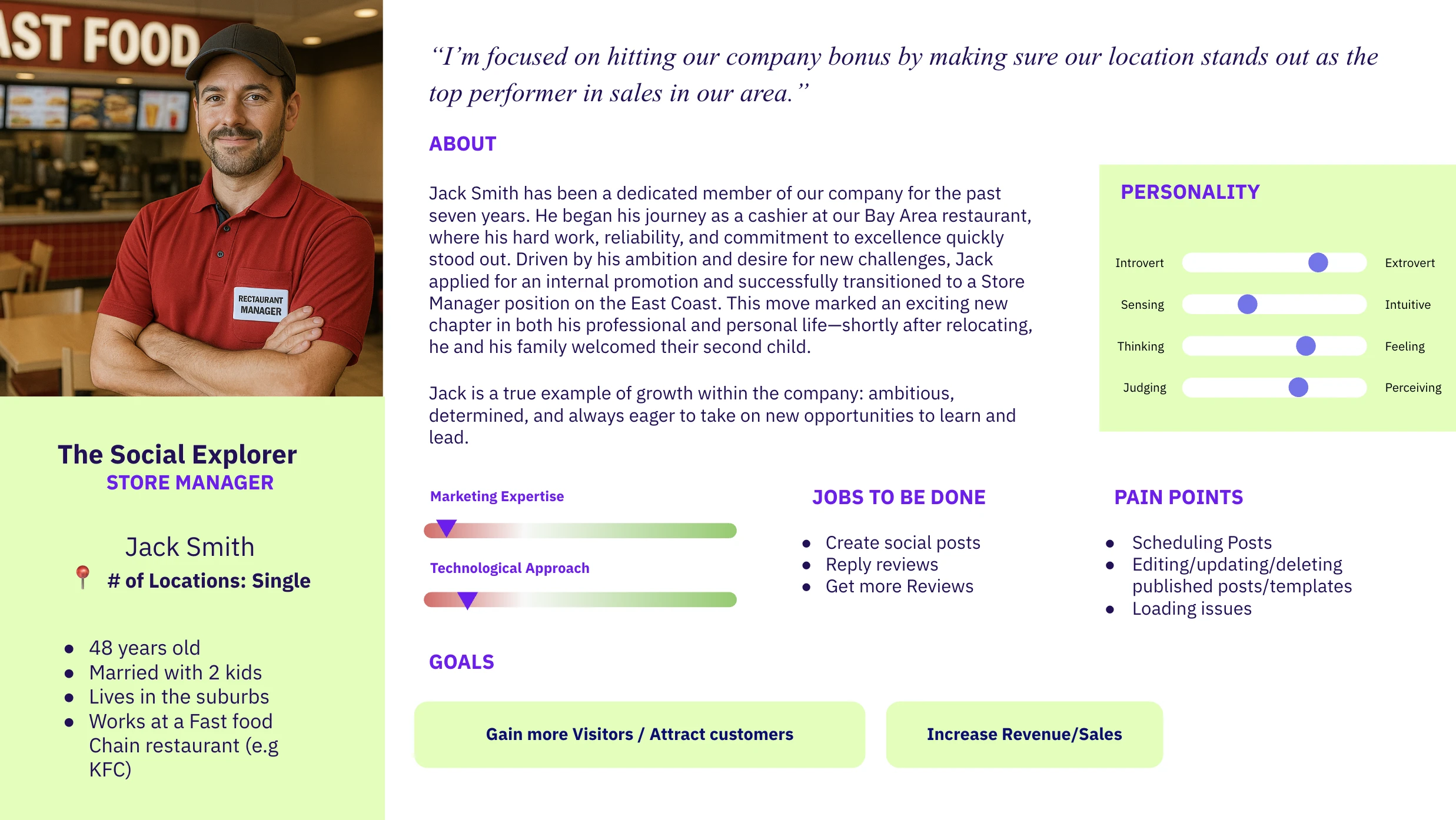
Store Managers
• Low technical confidence
• Manage up to 10 locations
• Focused on reviews, opening hours, and social responses
Key insight
The majority of abandoned AI sessions came from Store / Location Managers—users with low tolerance for complexity and high fear of making public mistakes.
Research & Insights

Key Abandonment Drivers
• Repeated clarification loops (IDs, confirmations, missing fields)
Eg:
User: “Help me improve my SEO”
Agent: “Which location do you want to optimize first?”
• High cognitive load and verbose, technical responses
• Expectation mismatch (bulk vs. single-location actions)
• Fear of acting on the wrong location publicly
• Unclear progress and effort required
Strategy
Strategy: Shift from Command-Driven AI to Confidence-Building Guidance.
AI-assisted prototyping in Figma allowed us to test AI interactions directly against production-grade design system components, reducing translation gaps between design and engineering and accelerating validation.
The ability to move at this speed was driven by reusable research insights, predefined personas, and AI-assisted synthesis workflows embedded across teams.
I led cross-functional alignment around a core shift: This foundation was critical to enabling the 2025 rollout of the UB-I Agent, ensuring users felt confident delegating actions to an autonomous system.
Design Concepts to Reduce Abandonment and Enable Agent Readiness

To reduce AI session abandonment and prepare users for agent-led execution, we introduced a small set of scalable interaction patterns applied consistently across AI and agent workflows.
1. Reduce Uncertainty
• Inline location identification and confirmation to prevent public-facing errors
• Clear progress indicators and previews to build confidence before execution
2. Maintain Momentum
• Contextual inactivity nudges that summarize progress and suggest next steps without pressure
3. Lower Effort
• Smart clarification and guided suggestions to minimize typing, decision fatigue, and ambiguity
4. Preserve Safety
• Save, edit, and resume mechanisms that allow users to recover, revise, or pause actions safely
Each pattern directly addressed a documented abandonment trigger while reinforcing trust, clarity, and readiness for autonomous agent execution.


Execution & Enablement
Using AI-assisted prototyping with the Zenit Design System embedded in Figma, we validated AI and agent interaction patterns as near-production experiences..
In parallel, I focused on organizational leverage:
• Standardized AI interaction patterns across 11 squads
• Integrated AI-safe workflows into the Zenit Design System
• Enabled non-UX teams to query research conversationally
• Accelerated synthesis using a 200+ study research repository
This prepared the UX foundation for the UB-I Agent by standardizing safe-action patterns, previews, confirmations, and recovery flows.
Results & Impact
Product Outcomes (Measured)
• AI-assisted task adoption increased by ~25% among SMB / Store Manager segments.
• Reduced fallback to manual UI by ~20%, signaling higher confidence in AI-led and agent-led execution.
• Lower support escalation signals related to “AI confusion” and “wrong location” actions in early post-launch monitoring.
Product Outcomes (Measured)
Chat abandonment reduced by ~18% within the first rollout cohort, driven by fewer clarification loops and earlier value perception.
Task completion rate increased from ~62% to ~74% for core workflows (opening hours, reputation responses, listing updates).
Average messages per successful task reduced by ~22%, indicating lower cognitive load and faster execution.
First-response success rate increased by ~30%, meaning users were more likely to progress after the initial AI reply.
Agent Readiness Impact (2025 Rollout)
• Leadership: Clear UX principles enabled faster, safer decisions across teams
• Delegation confidence improved, with users completing multi-step, agent-led actions without interruption more frequently.
• Drop-offs at confirmation steps decreased by ~15%, validating preview, reassurance, and reversibility patterns.
• Established a repeatable safety and trust framework that enabled broader rollout of the UB-I Agent across additional workflows.


