Keurig is one of the leading American brands in the United States, with at least 33 million households using a Keurig machine at home.
Keurig partnered with Testlio’s Usability Center of Excellence to de-risk the launch of its SMART brewer portfolio. As Director of the CoE, I led the research strategy, owned the engagement model, and delivered prioritized insights that directly informed product release decisions.

As Director of Usability, I built scalable research programs, strengthened executive partnerships, and worked with QA and QE teams to identify release-blocking usability issues before launch—reducing downstream risk and remediation costs.
Overview
Keurig wanted to understand how real users experience their SMART brewer unboxing to full device provisioning. The setup process spans physical assembly, mobile app installation, account creation, QR scanning, device discovery, and Wi-Fi connection.
Because this flow had not been systematically tested, failures at launch would likely result in increased returns, higher support volume, and negative first-use perception.
The business impact was significant: onboarding issues directly could increase frustration, returns, and early-stage abandonment.

The Problem
The provisioning flow had never been evaluated across iOS and Android devices.
Early assumptions suggested it was intuitive, but real users encountered:
• Android failures that blocked completion
• Confusing terminology (“Link” vs. “Connect”)
• QR-scanning issues
• Misleading “Get connected” CTA
• Unclear cross-device communication (app vs. brewer displays)
These issues introduced significant launch risk—particularly on Android—where failures could block setup entirely, leading to product returns, app abandonment, and negative ratings.
The goal
• Determine launch readiness of the SMART brewer provisioning flow
• Identify release-blocking risks across iOS and Android
• Inform engineering prioritization before launch
• Improve clarity, recovery, and cross-device communication
Research Insights

Quantitative
• SUS Score: 68 overall (85 iOS / 41 Android)
• 40% of Android users could not complete provisioning
• iOS users who completed flow rated clarity and navigation highly
• Setup satisfaction varied significantly based on device performance
Qualitative
• Expectation mismatch (“Get connected” misinterpreted)
• Platform-specific failures (QR scanning, permissions)
• Platform-specific failures (QR scanning, permissions)
Competitive Benchmark
• Reviewed connected-device onboarding flows
• Evaluated best practices in QR scanning and IoT device linking
• Benchmarked expectations for cross-device messaging
Benchmarking helped validate recommendations and reduced subjective debate across product and engineering teams.
Strategy & Concept Development

Core Strategy
Create a clearer, more guided provisioning experience that reduces confusion and supports device–app pairing across operating systems.
Why it works
• Sets realistic user expectations
• Clarifies terminology and reduces cognitive load
• Improves consistency across iOS, Android, and brewer prompts
• Minimizes risk of frustration and setup abandonment
This strategy reduced cognitive load, lowered setup failure risk, and supported scalable onboarding across future SMART devices.
Alignment
Supports Keurig’s goals of stable onboarding, reduces support tickets, and strengthens first-use satisfaction.

Execution Highlights

I led research synthesis and recommendation prioritization, working with product and engineering teams to align on fixes before release.
Visual & Structural
• Recommended clearer screen hierarchy for onboarding
• Proposed stronger visual differentiation between sign-in and sign-up
• Suggested improved color cues (e.g., green success checkmark)
• Revised “Get connected” and “Link” terminology
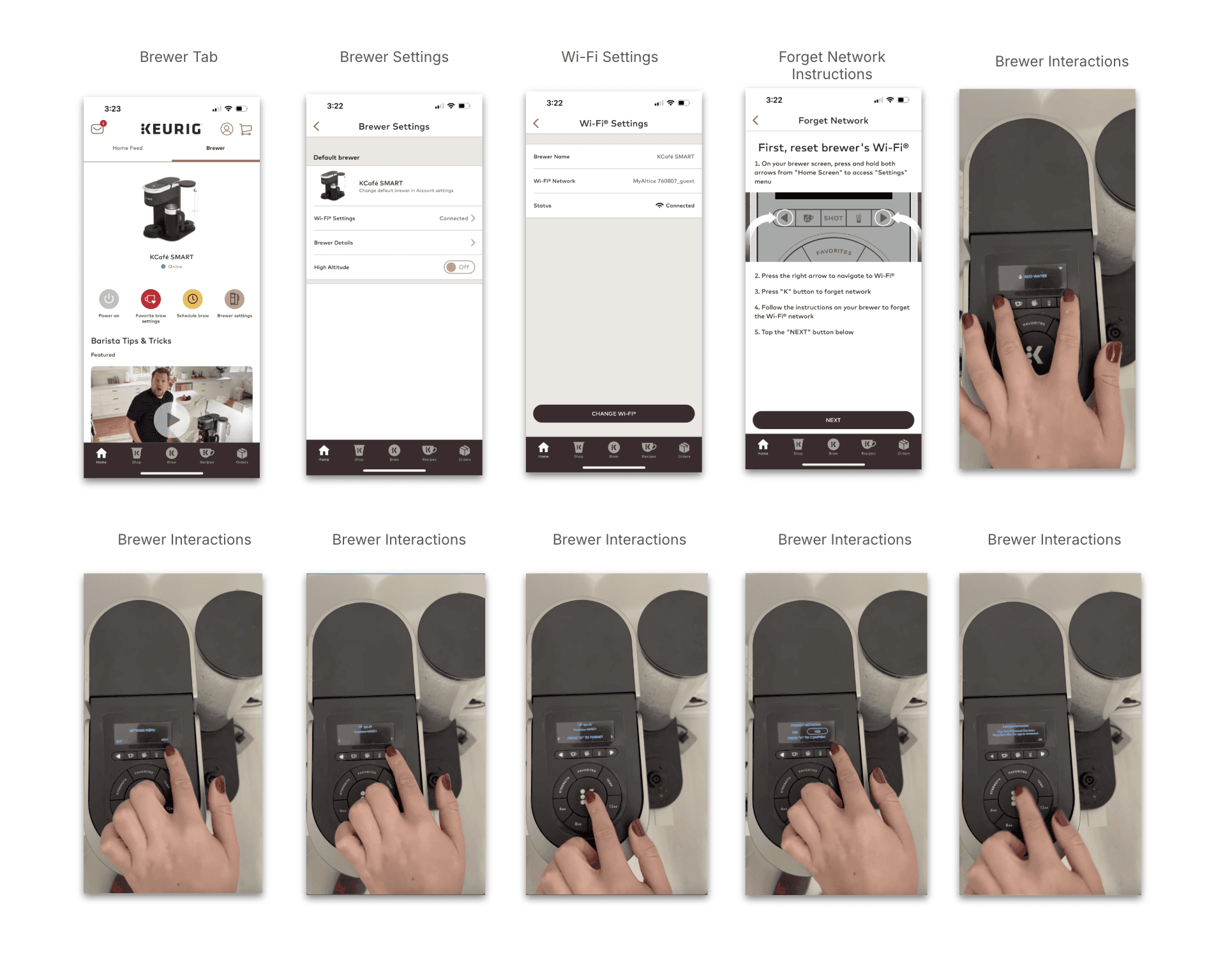
• Added troubleshooting guidance for QR scanning
• Improved app messaging around iOS Wi-Fi permissions
• Suggested adding an onboarding CTA on the home screen when no brewer is connected
Results
Business outcomes
• Prevented release of a flow containing multiple Android-blocking failures
• Reduced confusion points that would likely lead to returns and support calls
• Strengthened user readiness for SMART brewer setup
This prevented costly post-launch remediation and reduced the likelihood of early returns and support escalation.
Usability Outcomes
• Identified 21 usability issues
• Exposed 2 Android catastrophic failures
• Improved clarity of onboarding terminology
• Improved iOS usability while exposing Android-specific blockers requiring remediation
• Highlighted clear distinctions between intuitive vs. misleading cues
• Established a repeatable launch-readiness research framework for connected devices
Broader Business Impact
• Provided a repeatable testing model for future connected devices
• Enabled engineering teams to prioritize Android fixes
• Created guidelines for consistent cross-device communication
• Strengthened collaboration between hardware and mobile teams
Takeaways
• Leadership: Early usability validation prevents launch risk and downstream cost
• Strategy: Platform parity is critical for connected-device success
• Execution: Clear terminology and recovery paths reduce setup abandonment
• Future: Dedicated Android re-testing and guided provisioning flows


